Digital preservation
The Apparatus
Technical metal and mathcore, documented through concert footage and a growing archive.
KitchenGrade · Public data and MCP
I wanted to compare nearby restaurants before dinner. Building that comparison meant deciding when the inspection record was strong enough to put a letter beside a name.
By Paul Gendek · November 2026
01
Before KitchenGrade, I had to look up each restaurant separately, make sure I had the right location, then read its inspection and any follow-ups. I wanted to compare a few nearby places without doing that much digging just to pick dinner. The comparison had to be quick, and I still wanted to be able to open the actual report.
KitchenGrade calculates its own letter grades from public Florida Department of Business and Professional Regulation inspection records. It weights high-priority, intermediate and basic findings at five, two and one point. Before those counts can support a current letter, the app checks whether the record belongs to the right location and owner, whether the visit qualifies, and whether the dates, visit sequence, findings and outcomes support the result. Florida publishes the inspection findings and dispositions.
02
One Winter Garden Domino’s shows why the date matters. Its September 24, 2025 routine inspection recorded six basic findings, which worked out to six points and a B under KitchenGrade’s method. After 12 months, the app showed B → ? and explained that the grade was based on an older inspection. A diner could still see the B, its date and the linked state report. I asked for the reason to appear beside the grade in both the results and the detail view, so a reader could understand the question mark at a glance.
A year seemed reasonable to me. My priority was that the earlier letter stay visible and that its age be clear. Florida’s annual license renewal and risk-based inspection schedule are separate from this rule. The 12-month window determines whether KitchenGrade can use a full inspection for a current letter.
The same distinction mattered when ownership changed. A dated letter can still tell you about the business that was inspected. I wanted the app to keep that history visible and identify the previous business, so a reader could see whose record they were looking at.
03
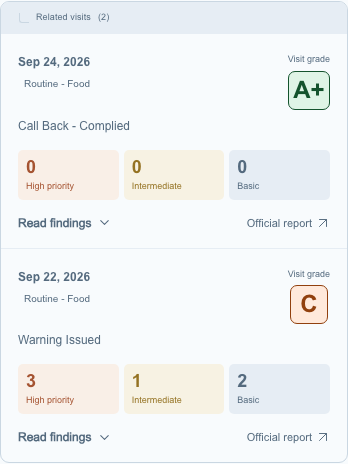
At Avalon Diner, the September 22, 2026 routine inspection recorded three high-priority, one intermediate and two basic findings. KitchenGrade calculated 19 points, a C. Two days later, a linked follow-up recorded zero findings and a complied outcome. The app showed the change from C to A+.
If an inspector came back and confirmed the problems were fixed, I wanted the grade to reflect that. The rule requires the same recorded owner and inspection episode, a reliable sequence, reconciled counts and a recognized complied outcome. The original full inspection still sets the age window. A partial complaint with zero findings supplies no letter of its own.
I asked for a letter beside each visit because the summary alone didn’t tell me which inspection supplied which grade. The coding agent reused the existing method on the recorded owner’s history as of each visit and only showed a letter when that visit supplied the grade. On the live site, I opened the history, checked the C beside the original visit and the A+ beside the follow-up, and confirmed that the original findings were still visible. The agent also ran automated checks and verified the two rows in a production browser. A separate regression check confirmed that a zero-count partial follow-up could sit next to a B from a full inspection’s callback without supplying a letter of its own.
04
I ran into a different version of the same problem when I asked ChatGPT for dinner options on the way home. It found candidates, but its web tools couldn’t retrieve live KitchenGrade grades. My browser could display the records, and direct checks later retrieved the public data. We couldn’t establish the cause of the retrieval failure.
I asked for read-only access to the public records and cared that ChatGPT got the grade for the exact location. Two places with the same name can have very different inspections. The coding agent implemented the connection as two read-only Model Context Protocol (MCP) tools. Search finds candidate locations and returns their public establishment IDs. The second tool looks up the dated grade and a link to its inspection report for one exact ID using the same logic as KitchenGrade’s public API.
In October 2026, the agent searched for Spoleto in Winter Garden and Soupa Saiyan in Orlando, looked up the exact IDs, and compared the results with the live public API’s single-record and batch responses. The grades, dates, violation counts and report links agreed. An unknown ID returned no grade. The connected check also found that ChatGPT still advertised an older county list. After refreshing the tool metadata, the agent verified a county-filtered search in a fresh chat. Checking the server alone would have missed the difference.
05
After shipping, I was surprised how hard it was to find somewhere to eat that met my B-or-better threshold. That made the date and the follow-up more useful to me. I could compare nearby options first, then see the inspection behind a letter and decide how much weight to give it.
Signal & Habit
Context Matters.
A project in the independent collection by Paul Gendek.
Project overview at Signal & HabitTechnical metal and mathcore, documented through concert footage and a growing archive.
 Browser audio
An adjustable browser backing band for guitar practice, with hands-free controls on supported setups.
 Camera UX
Recreate an earlier photo so your before-and-after comparison lines up.
 Nutrition data
Scan a food product and see its nutrition against your own daily targets.
 Feedback-led design
A taste tool. Rate restaurant water by taste and share how it was served.
 Explainable discovery
A film discovery tool in public alpha. Follow the work of editors, composers and other crew members across films.